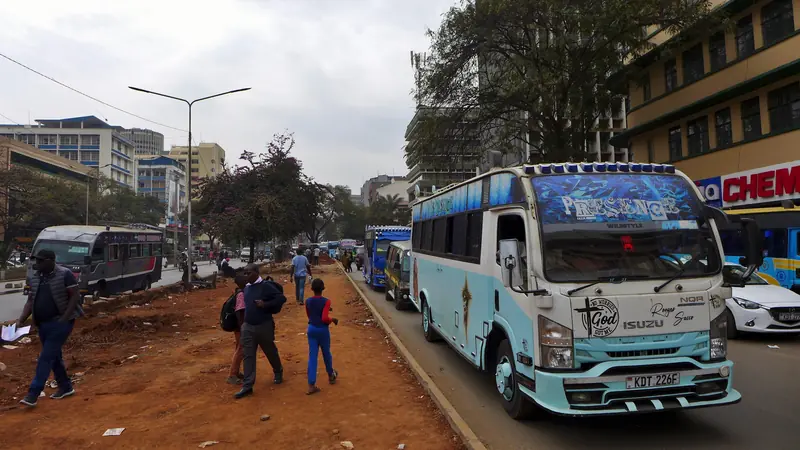
 Photo: Bahnfrend, Wikimedia Commons, CC BY-SA 4.0
Insurance (Motor Vehicle Third Party Risks) Act, Cap 405 Laws of Kenya
What it requires of drivers
Free, no obligation. Only insurers and brokers licensed by IRA Kenya receive your request.
Get free quotesOn this page · 10 sections
- The law: Cap 405 at a glance
- Cap 405 section by section
- Who is covered — and what the legal minimum does not cover
- Section 10: when the insurer must pay a judgment
- The structured compensation schedule: what it was and where it stands
- The penalty for driving uninsured
- Cap 405 in practice: a checklist
- How to check a motor insurance certificate
- FAQ
- Sources
The law: Cap 405 at a glance
Section 4(1) of the Insurance (Motor Vehicle Third Party Risks) Act says no one may use a motor vehicle on a road — or let someone else use it — unless a valid policy of insurance or security covering third-party risks is in force. Government vehicles, and farm tractors moved between parts of the owner's land, are exempt (section 4(3)).
Section 5(b) sets what the policy must cover: liability for the death of, or bodily injury to, any person caused by the use of the vehicle on a road. Section 5(a) adds that the policy must come from a company allowed under the Insurance Act (Cap. 487) to carry on motor insurance business — check it on IRA's list of licensed insurers.
The Act was assented to on 3 April 1945 and commenced on 1 October 1946. This page follows the Kenya Law text revised to 31 December 2022; its latest amendments are the Insurance (Motor Vehicle Third Party Risks) (Amendment) Act, 2013 (Act No. 50 of 2013) and the Companies and Insolvency Legislation (Consequential Amendments) Act, 2015 (Act No. 19 of 2015).
Cap 405 section by section
| Section | What it says |
|---|---|
| s.4 | No use of a motor vehicle on a road without a third-party policy or security; the offence and its penalty |
| s.5 | What the policy must cover (death or bodily injury to any person) and what it may leave out, including any sum above KES 3 million for one claimant |
| s.7 | The insurer issues a certificate of insurance to the policyholder, in the prescribed form |
| s.9 | The certificate must be carried and displayed on the vehicle; after an injury accident it must be shown to the police within 24 hours if not inspected at the scene |
| s.10 | The insurer must pay judgments against the insured for the liabilities of s.5(b), within the conditions of the section |
| s.12 | A person facing a claim must say whether they were insured and give the certificate details; the insurer must admit or deny liability in writing |
| s.13 | When a policy is cancelled, the certificate goes back to the insurer within 7 days (or a statutory declaration if it is lost) |
| s.16 | Policy clauses restricting cover by the driver's age, the vehicle's condition, the number of passengers and similar matters have no effect against third-party claims |
| s.17 | General penalty for offences under the Act: a fine up to KES 500,000, up to 1 year in prison, or both |
Who is covered — and what the legal minimum does not cover
The compulsory policy protects third parties: pedestrians, other road users and, in some vehicles, passengers. Under section 5(b), it does not have to cover:
- your employees injured in the course of their work;
- passengers — except in vehicles carrying passengers for hire or reward (matatus, taxis) or under a contract of employment;
- liability you took on by contract;
- any amount above KES 3 million for a claim by one person.
Damage to other people's property is not part of the statutory minimum, and damage to your own car never is. Both come with broader policies — see third-party vs comprehensive. Matatus, taxis and ride-hailing cars carry passengers for reward, so their passengers must be covered: see commercial vehicle insurance.
Section 10: when the insurer must pay a judgment
If a court gives judgment against an insured driver for a liability that s.5(b) requires the policy to cover, section 10(1) says the insurer must pay the person entitled to the judgment — including costs and interest — even if it is entitled to avoid or cancel the policy, or has already done so. This is what protects a victim when the policyholder breached the policy terms.
Section 10 lists the cases where the insurer does not have to pay:
- the insurer had no notice of the court case before or within 30 days after the proceedings began (s.10(2)(a));
- execution of the judgment is stayed pending an appeal (s.10(2)(b));
- the policy was cancelled before the accident and the certificate was surrendered or declared lost, or the insurer notified the Registrar of Motor Vehicles and the Commissioner of Police within 28 days of the cancellation (s.10(2)(c));
- the insurer obtained a court declaration, in an action started before or within 3 months after the victim's case, that the policy was obtained by non-disclosure or a false statement of a material fact (s.10(4)).
Section 12 adds the steps before court: once served with the claim, the insurer must admit or deny liability in writing, and after an admission the claimant allows it up to 60 days to settle, with arbitration or mediation during that period (s.12(1A)–(1B)). To find the insurer, ask the driver for the certificate details (s.12(1) obliges them to give them) or run a DMVIC check on the vehicle.
The structured compensation schedule: what it was and where it stands
The 2013 amendment (Act No. 50 of 2013) added a Structured Compensation Liability Schedule to the Act and a proviso to s.10(1): a judgment would be paid only up to a percentage of the KES 3 million limit, set for each injury (for example 100% for total blindness or quadriplegia). The Kenya Law revised text still prints the Schedule.
The schedule was challenged in court. On 20 April 2018 the Court of Appeal (Civil Appeal 141 of 2016) dismissed the appeal against the High Court judgment of 5 April 2016 in Petition 148 of 2014 and agreed that section 3(a) of the 2013 amending Act (the proviso) and section 6 (which introduced the schedule) are null and void. The court found that the schedule cannot be applied to any judgment, and said it would be best left for settling claims before other dispute-resolution forums.
In practice: a settlement offer worked out from the schedule's percentages does not bind a court, which assesses compensation on the evidence; the insurer's duty under s.10 still stops at the KES 3 million per-claimant limit of s.5(b)(iv). Take legal advice before accepting an offer.
The penalty for driving uninsured
| Offence | Penalty under Cap 405 |
|---|---|
| Using an uninsured vehicle (s.4(2)) | Fine up to KES 10,000, or up to 2 years' imprisonment, or both |
| Driving licence | The court may disqualify you for 12 months on a first conviction, and must on a second, unless there is a special reason |
| Other offences: not displaying the certificate (s.9), not giving insurance details to a claimant (s.12), not surrendering a cancelled certificate (s.13) | Fine up to KES 500,000, or up to 1 year's imprisonment, or both (s.17) |
Failing to display the insurance certificate
Section 9(1) requires the certificate to be carried and displayed on the vehicle, and s.9(3) makes failing to display it an offence, punished under the general penalty in s.17 (table above). How a charge is written matters: in Republic v Njoroge (Nakuru, sentence of 11 February 2025), a motorcyclist pleaded guilty to riding without a licence, without a helmet and without displaying a certificate of insurance; the magistrate found the insurance count was "based on a none-existent or wrong provision of the law" and discharged him on it, while fining him KES 1,500 on the licence count (Kenya Law). One sentence in one court is not a rule: displaying the certificate remains a legal duty, and driving with no cover at all is the separate s.4 offence above.
Enforcement comes from the police, who check certificates on the road and after accidents (s.9); the courts, which convict and hear claims; and the Insurance Regulatory Authority, which licenses the insurers that may issue the policy.
Cap 405 in practice: a checklist
- Buy at least third-party cover from a licensed insurer before the vehicle goes on the road (s.4, s.5(a)).
- Check the certificate is genuine on *352# or AKI's Bima Yangu app, and keep it displayed on the vehicle (s.9(1)).
- After an accident with injury, show the certificate to the police within 24 hours if no officer inspected it at the scene (s.9(2)).
- Notify your insurer at once: s.10(2)(a) requires the insurer to have notice of any court case within 30 days of its start.
- If someone claims against you, give them your insurance details from the certificate (s.12(1)).
- If you cancel the policy, return the certificate to the insurer within 7 days (s.13).
Cannot pay for a full year? Some licensed insurers sell third-party cover by the month, for cars and motorcycles: see one month third-party insurance in Kenya. The same Cap 405 minimum applies, and a month not renewed is a month uninsured. Or ask several licensed insurers for third-party quotes.
How to check a motor insurance certificate
Motor certificates in Kenya are digital. The Association of Kenya Insurers runs the DMVIC system: to run a DMVIC check, dial *352# or scan the QR code with AKI's Bima Yangu app to see the insurer, the vehicle, the cover dates and whether the certificate is genuine. There is also a web check.
A World Bank study of compulsory motor third-party insurance in developing countries (Gönülal, 2009) found that motorists often see it as a tax they can evade rather than as protection against their own liability — yet s.10 is what lets a victim be paid without suing you personally. To compare policies, ask licensed insurers for quotes.
Already insured?
Next step
Frequently asked questions
What does the Insurance (Motor Vehicle Third Party Risks) Act Cap 405 require?
That no motor vehicle is used on a road without a policy, from a licensed insurer, covering liability for death or bodily injury to other people (sections 4 and 5). The certificate must be displayed on the vehicle (s.9).
Is third-party motor insurance compulsory in Kenya?
Yes. Section 4 of Cap 405 makes it an offence to use a vehicle on a road without it. Only government vehicles and farm tractors moved between parts of the owner's land are exempt.
What does section 10 of Cap 405 say about the insurer's liability?
The insurer must pay a judgment obtained against the insured driver for death or bodily injury, with costs and interest, even if it could cancel the policy — provided it had notice of the case within 30 days of its start and no exception of s.10 applies.
Is the structured compensation schedule in Cap 405 still in force?
It is still printed in the Kenya Law text, but on 20 April 2018 the Court of Appeal (Civil Appeal 141 of 2016) upheld the High Court and held the schedule and the proviso to s.10(1) null and void, so it cannot cap a court judgment.
What is the penalty for driving without insurance in Kenya?
A fine of up to KES 10,000, up to two years in prison, or both (s.4(2)), and a 12-month driving ban that the court may order on a first conviction and must order on a second, unless there is a special reason.
Does third-party insurance in Kenya cover damage to the other car?
It is not required by Cap 405, which only requires cover for death or bodily injury. Many third-party policies add property damage up to a limit — read the policy schedule.
What is the maximum compulsory third-party cover per person in Kenya?
Cap 405 does not require cover above KES 3 million for a claim by one person (section 5(b)(iv)).
How do I verify a motor insurance certificate in Kenya?
Dial *352#, scan the certificate's QR code with the Bima Yangu app of the Association of Kenya Insurers, or enter the certificate number on verify.dmvic.com (DMVIC).
What is the fine for failing to display insurance in Kenya?
Not displaying the certificate is an offence under s.9(3) of Cap 405 (the duty to display is in s.9(1)), punished under the Act's general penalty in s.17 — a fine of up to KES 500,000, up to one year in prison, or both; the court sets the actual amount. Driving with no cover at all is the separate s.4 offence (up to KES 10,000 and/or two years).
What happens if you are caught driving a motor vehicle without insurance in Kenya?
You can be charged under s.4 of Cap 405: a fine of up to KES 10,000, up to two years in prison, or both, and a possible 12-month driving ban. If you injure someone, you also face the claim personally, because no insurer stands behind you under s.10.
Are passengers in a private car covered by compulsory insurance?
No — Cap 405 only requires passenger cover for vehicles carrying passengers for hire or reward, or under a contract of employment. Ask the insurer for passenger cover on a private car.
Sources
- Insurance (Motor Vehicles Third Party Risks) Act, Cap. 405 — Kenya Law
- Court of Appeal of Kenya — Justus Mutiga & 2 others v Law Society of Kenya & another [2018] KECA 338 (KLR), Civil Appeal 141 of 2016, 20 April 2018 — Kenya Law
- Republic v Njoroge (Traffic Case E239 of 2025) [2025] KEMC 27 (KLR), Nakuru Law Courts, sentence of 11 February 2025 — Kenya Law (Web Archive copy)
- Insurance Regulatory Authority (IRA) Kenya — official website
- Association of Kenya Insurers — digital motor insurance certificates (DMVIC)
- DMVIC — verify a motor insurance certificate
- IRA Kenya — Licensed Entities 2026 (notice under section 184 of the Insurance Act, dated 30 March 2026)
- Gönülal, S. O. (2009). Motor Third-Party Liability Insurance in Developing Countries: Raising Awareness and Improving Safety. World Bank. doi:10.1596/12960